Feeds:
Posts
Comments

Archive for the ‘Uncategorized’ Category

Paris Pages


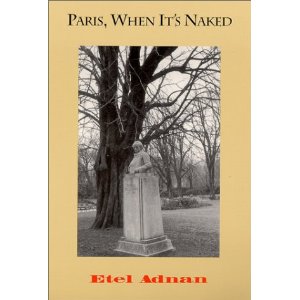
For me, real virgin territory would be that place I had never visited before–in books. While maps, museums, art, theater and films all aid me in imagining that spot I am heading for, nothing brings me there like the written word. So, as I prepare once more to go to Paris, where over decades I have visited, lived, studied and written, I return to beloved tomes—my personal primer—to remember where I’ve been, and new ones to help me find where I am going.
It is easy for me, as a lapsed medievalist, to still see the Paris of Heloise and Abelard in the twisting streets of the Latin Quarter where he was her tutor. Or to sympathize with Eleanor of Aquitaine, the fifteen-year-old bride of the hapless Louis VII, who, missing her sunny Provence, complained of the primitive, smelly court at the Cité Palace and the dreadful cold of Paris. I have learned French manners from the acid wit of Moliere and Voltaire, and of revolutionary times from the wise letters of Mme. de Stael and the historical prose of Victor Hugo.
For me, poetry was reinvented with the great Symbolists—Baudelaire, Rimbaud, Verlaine, Mallarme—who haunted the bohemian districts of Paris in the late 19th century. The 20th century brought the Seine that runs eternally under Le Pont Mirabeau, as Apollinaire described in his poem of the same name, and a city eternally divided by the Left (Bourgeois) and Right (Aristocratic) Banks as Proust defined them.
As for the ‘20s and ‘30s, it’s hard to walk anywhere without running into the ghosts, and words, of the writers–James Joyce, Gertrude Stein, F.Scott Fitzgerald, Anais Nin, Henry Miller—to name a few, who have created modern Paris in my mind. Hemingway seems to have left his mark in every second bar in town, and the Left Bank streets I love are haunted by the post-war existentialists. I’m pretty sure I even had coffee once with Simone de Beauvoir at Deux-Magots.
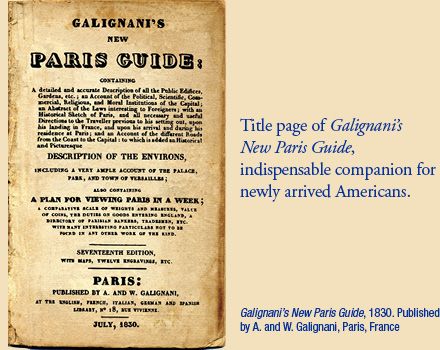
This incomplete list reveals only some of the literature so important to my understanding of Paris and its eternal transformations. While it spans centuries, I have another collection of books–travel guides–that span the decades of my own experience. They, too, are dog-eared and highlight a Paris,and a personal past, that is transformed. The teen-age student who first arrived there is now a grandmother, and the days of living well on $5 seem a distant dream. Sites I once loved, such as the Jeu de Paume Museum, which housed many Impressionist masterpieces, and Les Halles, the vast central market with its all-night delivery of fresh produce and hot onion soup, are no more. Meanwhile, new structures have risen: the Pompidou Center, the opera house at the Bastille, the huge complex of La Défense.
So as I get out my passport to revisit the City of Light and share its wonders with the Wanderland Writers Workshop, I’ll look over the old maps, books and guides again. But much as I love those dog-eared pages, and memories, I also know that to fully experience Paris is to carry its past, and mine, into the present. I’m looking for new works, new corners of the city, new encounters to write my next chapter. The most important book I’m bringing is one of blank pages.

See also Left Coast Writers, http://www.leftcoastwriters.com
Read Full Post »

Booking Paris

In that Getting Ready for Paris mode, where I will be in September with my merry band of writers, the best part is to revisit my old best friends, books. Since the works on, of, and about the City of Light are vast, the prudent course is to pick a few favorites. (more…)

Read Full Post »

Livre La France*


“Books are living things. They need to be respected, to be loved. We are giving them new lives.” So declared Andrée Le Fauo, a retiree dedicated to giving away used books near the Montmartre district of Paris, according to a recent article in the New York Times. ( “The French Still Flock to Bookstores,” by Elaine Sciolino, June 21, 2012). (more…)

Read Full Post »

The critics raved about the play In Paris created by Dmitry Krymov and based on a prize-winning story by Ivan Bunin, which debuted in Northern California at the Berkeley Rep. Since it’s set in the City of Light in the ‘30s, with the incomparable Mikhail Baryshnikov playing an exiled Russian general, it seemed an event not to miss. So I didn’t. But, evidently, I did miss its heart and soul.
“An ephemeral dream of last romance,” said the San Jose Mercury News. “A moody, wryly comic blend of engaging visuals, enchanting found-object music and romance,” declared the San Francisco Chronicle, while the Huffington Post applauded the “play’s commitment for getting the emotion out to the audience.”
Really?
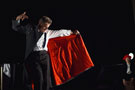
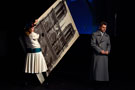
While I do go along with the great visuals, beginning with the sepia-toned huge postcard of Paris carried in sideways to open the play;

the funky running English text for the dialog delivered in French and Russian; and agree the presence of Baryshnikov, as actor, is commanding (along with the quite lovely Anna Sinyakina), the rest escaped me. From the revolving set and anonymous “others” to the vague evocation of the real Paris, I found myself, rather like Anna herself, upside down on an invisible swing, trying in vain to connect with something, to connect with him.
I can grasp it best by analogy. If this were a painting, it would be a René Magritte, with a figure in tails and a top hat on a head helpfully removed from the body.
If it were a poem, it would be “Ode to a Grecian Urn” by Keats, in which the lovers don’t quite kiss. For eternity.
If it were a novel, it would be Russian for sure: “Dr. Zhivago,” where close to the end, Zhivago finally sees his beloved Lara from a streetcar window as she is walking along a Moscow street. He gets off the streetcar and begins to run after her, only to collapse and die without her ever knowing he was there.
If this were an opera, it would definitely not be Carmen. Although the play finishes with a graceful flamenco performed by the great Baryshnikov, he is not the toreador. There is no vanquished bull, no great love waiting to receive his gift, no passion. But oddly, at the end, with this kind of resurrection dance after death, the play comes to life as it has not before and gives a poignant salute to the passion, love and, yes, poetry, that might have been.

Read Full Post »

Cara Black and Flashbacks to Paris Noir

We all know that Proust could conjure worlds by dipping his famous madeleine in a teacup. I found that listening and talking with mystery writer Cara Black, creator of the unstoppable, smart and thoroughly modern detective Aimée Leduc, had the same effect on me. Hearing Black’s memories, and wandering the shadowy streets and dark underbelly of Paris with Aimée, sent my own memories wandering too.

Black regaled an audience of Left Coast Writers recently with how she first arrived in Paris as an eighteen-year-old wearing a lumberman’s jacket and boots and boldly went unannounced to knock on the door of celebrated writer Romain Gary. Since he had politely responded to a fan letter she’d written him, she figured he’d be happy to see her. My own first moment was also tinged with the ridiculous. Like Black, I had hitch-hiked all over, so for my arrival at age nineteen, my transportation was by large truck. Joining the affable truck driver. in smoking Gauloises, I decided I needed to look chic for my grand entrance in the City of Light. So I added a skirt, hose and heels to my ensemble — much enhanced I’m sure, by a battered suitcase.

I asked Black if, upon arrival, her French was actually up to the task of speaking with Romain Gary. She laughed and said her schooling with French-speaking nuns had given her a fluency and vocabulary that was vintage end-of-nineteenth century. In that respect, I can match and raise her one. By the time I arrived, I had taken so many French lit. classes, and devoured so much grammar, that a Parisian friend joked she loved getting my letters straight out of the eighteenth century. Tongue-tied and stumbling when first trying to communicate, I’m sure I made a verbal leap straight to the Middle Ages.

For both of us, that initial trip was indeed just a beginning, and we have returned to Paris over our lives for pleasure, for work and for love, because one never outgrows the ability to be besotted with Parisian charms.

Black spoke of taking her son there as a child, and his complaints at being dragged to another museum. I remember the cry of my own children, “no more churches,” and their happiness with an expedition I sent them on. Like Aimée Leduc, who wears a Tintin watch, they were great Tintin fans. So without adult supervision, I sent them armed with a map, Metro tokens, some Euros and their middle-school French to the Tintin bookstore. A ragged collection of taped-together Tintin books in French is still kicking around my house.

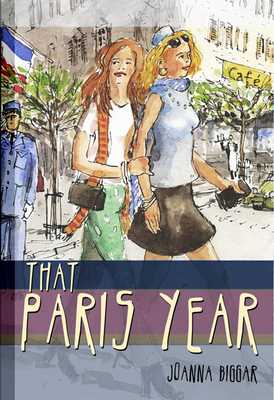
The ripples of similar experiences sparked by Black and her detective go on and on. I, too, have written a novel, if not a mystery, based on early experience in Paris, That Paris Year. But whereas I’m just working on a sequel, Black is the author of an acclaimed series of murder mysteries set in various Parisian neighborhoods. Her twelfth, Murder at the Lantern Rouge, is just out. I can’t wait to read it. And to check out that little-known part of the Marais, where it is set, when I go with our group of travel writers to Paris in September.

Read Full Post »

Indochine

What’s in a word? An impression, a sound, a scent, an evocation? All of that and more in the word “Indochine” which exists in films and books and calls up tropical heat in fragrant gardens, broad tree-lined boulevards in the formal French manner, (more…)

Read Full Post »

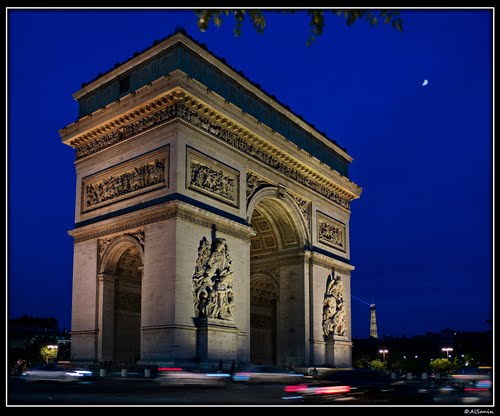
Those blurs zipping around the base are CARS

My first exposure to traffic in Paris was dizzying, and nowhere more than in the madness zooming around the Etoile, where cars circulate at mad speeds according to rules only divined by those with French blood types. (more…)

Read Full Post »

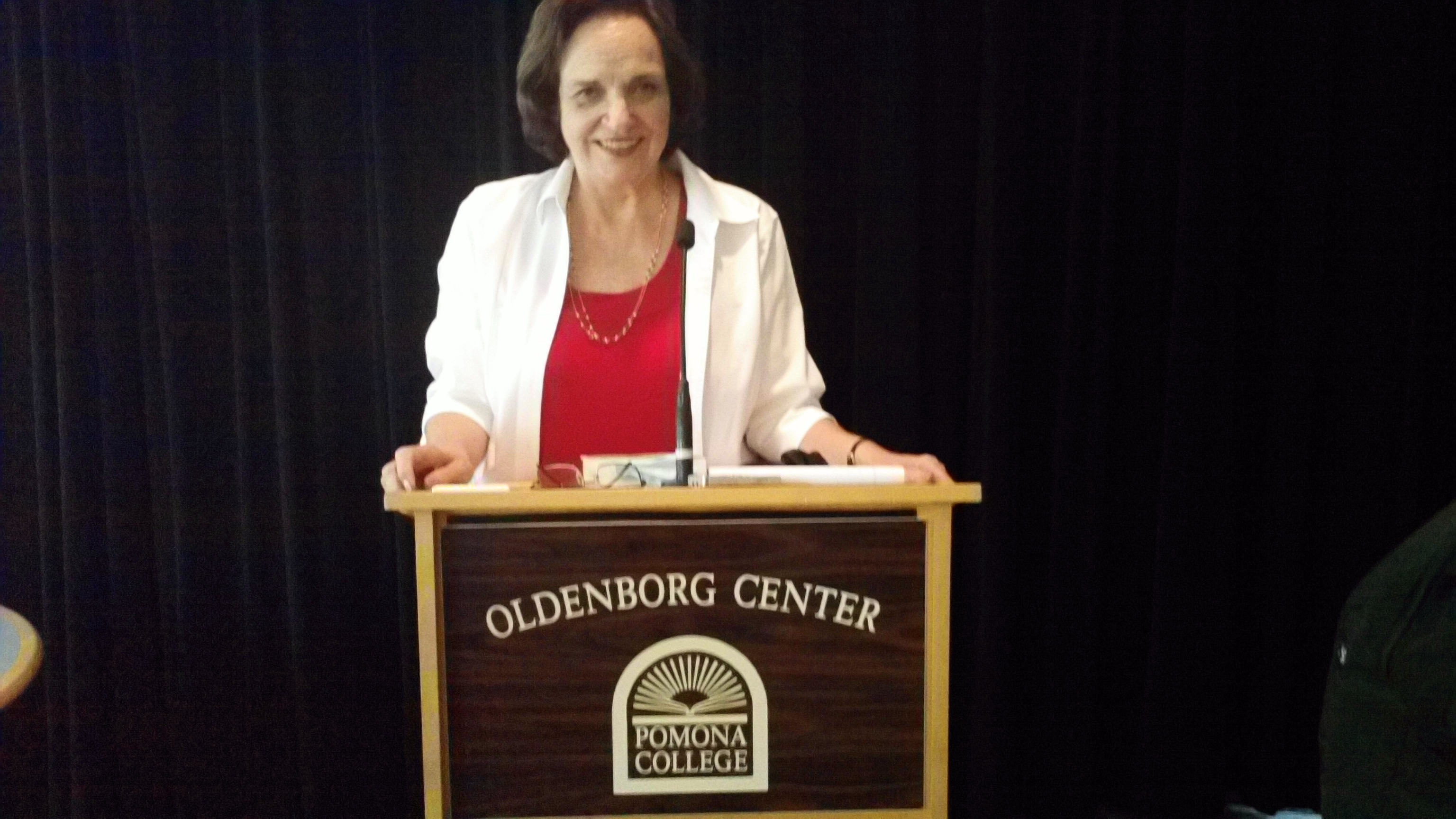
Yesterday I had the lovely experience of time-travel, only the gate I passed through did not take me to some imaginary historical moment or gauzy future, but rather to my own past. A classmate who came to hear me address the students of my alma mater, Pomona College, had the experience, too. He saw me on the street and said, “ah, there’s Jo Wallace,” a person I used to be a long time ago.

So, through that long lens of time I got to revisit a place, with all its sensations, I used to live in decades in the past, and share it with others who were there, including my favorite French professor, Leonard Pronko, and many others who were not. The bond we had, and the affection we shared, centered on Paris and its delights, the eternal allure of France and all its seductions.

I also got to experience time travel of another sort by reading the opening pages of my novel, That Paris Year, and discussing them with a large group of students —  just like the narrator J.J. comes to discuss Paris with a group of students in those same pages. Although it was assumed that I am in fact J.J., and therefore I had really done this before, the truth – stranger than fiction – is that I am not that fictional character. Nor had I ever addressed that audience about France before. So it was a delicious moment of life imitating art, or perhaps the other way around?

Time travel, where all the niggling boundaries between reality and un-, fact and fiction, here and there, melt away. If you’ve not gone there, get your passport now.

Read Full Post »

Ici ou La? There, There

(more…)

Read Full Post »

Guide to Paris from David McCullough's Book

J.J. here – There’s a new book out about Americans in Paris, called The Greater Journey, by historian David McCullough. It’s about influential Americans who went to Paris to learn stuff they couldn’t learn at home. Although many went for their formal education, such as in art schools, most often the real education was along more esoteric lines, such as about style, manners, wine, and oh yes, sex.

Going to France for a real education is nothing new. What Thomas Jefferson learned about wine resulted in a burgeoning wine industry at Montecello. Manners? Well, probably nobody bested Mr. A. Billfinger, a.k.a. Ferguson, the starring rogue of Mark Twain’s “The Innocents Abroad.” As for sex, where to begin? Maybe with Hnery Wadsworth Longfellow who wrote to friends about the “naughty women” of Paris. Or with Duke Ellington’s 70th birthday party when three naked dancers jumped out of a camembert-shaped cake?

In the 20th century, seems like each decade had it’s own character with exiled Americans front and center. The Jazz Age of the ‘20s with Hemingway, the Zelda and F. Scott, Gertrude Stein and Alice, and Josephine Baker mingling with all those musicians.

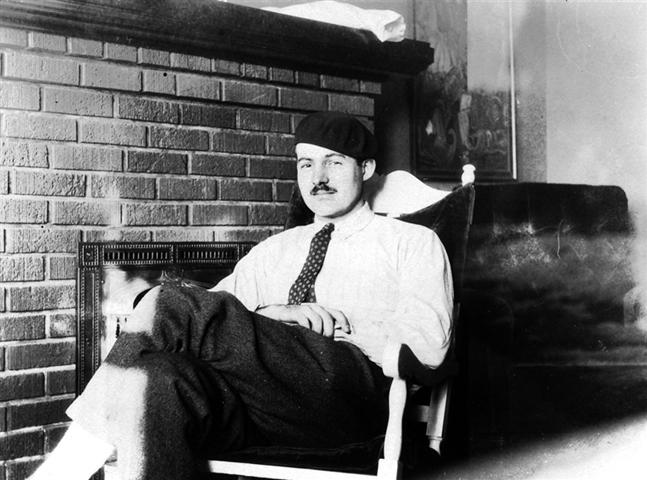
Hemingway in Paris

The ‘30s added more artists and writers working in their garrets such as Henry Miller and June Miller and Anais Nin, and of course the ‘40s brought the War, Americans liberating Paris, and the indelible images of film noir epitomized by Bogie getting on that train to leave Paris in “Casablanca.” With the ‘50s came a return to style, life, and American writers such as Janet Flanner and Art Buchwald reporting it all while the great existentialists scribbled in Left Bank cafes.

But the ‘60s? Nobody has done much to record how Americans participated in that tumultuous decade in Paris that began with J.F.K.’s triumphant trip in 1961 – with the American Queen of Style, Jackie, at his side – and ended with riots in the streets in ’68.

La Jacquie


But, hey, I was there and told my story and that of my friends in a book. Maybe others should too. Any thoughts from others of you who were there, too?

Read Full Post »

« Newer Posts - Older Posts »